

Pilot Purgatory
A Story of AI Transformation
By Scott Weiner (AI Lead at NeuEon, Inc.), inspired by conversations with Erwann Couesbot (CEO of FlipThrough.ai)
Note: This is a work of fiction. All characters, companies, and events are fictional composites created for illustrative purposes. While the industry statistics cited are real and sourced, the narrative is designed to illuminate common patterns in enterprise AI adoption, not to depict any actual organization or individuals.
This is Part 7 of a serialized story exploring why enterprise AI initiatives fail, not from lack of technology or talent, but from invisible organizational dynamics that doom them from the start.
Reading the series for the first time? Start with Part 1: The Mandate
Previously in Pilot Purgatory…
The crisis was over. The chatbot was fixed. The remediation was complete.
And then came the reckoning.
Marcus sat in his darkened home office at 11:47 PM, reading industry research about AI adoption failures. McKinsey: only one-third of AI projects scale beyond pilot. Gartner: 30% of generative AI projects abandoned after proof of concept. The patterns described were uncomfortably familiar.
The fourth engineer left on a Thursday. Kevin Rodriguez, the infrastructure specialist, headed to Strathmore – the competitor. “They’ve got a Chief AI Officer,” Kevin said in his exit interview. “Someone whose whole job is making AI work. Not a CTO trying to fit it in between everything else.”
Vendor integration costs spiraled. Cloud spend ran 40% over projection. Linda called with another surprise: $150,000 for a feature they’d assumed was included. “I recommend we acknowledge that I bought the wrong solution,” she said. “We applied the same frameworks we use for ERP systems and security tools, and those frameworks don’t work for this.”
Priya, still at her desk at 9 PM, caught a procurement AI recommending 200 units of a recalled component. “We’re not behind because the technology doesn’t work,” she said. “We’re behind because we’re trying to build a house on quicksand and wondering why the walls keep cracking.”
David scheduled a check-in. “Talk to me. Not the board version. The real version.”
“We’re stuck,” Marcus said.
He started a blank board presentation. Eight weeks until Jennifer’s questions. Eight weeks to articulate a problem that was easier to feel than to name.
On his desk, the paper Sarah had given him sat on top of the pile. “Pilot Purgatory,” the title read. Someone had named it. He just hadn’t been ready to use the word until now…
Chapter 7: The Question
The weight settled into Marcus’s chest before he was fully awake.
He lay in bed for a moment, watching the early June light filter through curtains that needed washing, trying to identify the source of the heaviness. Then he remembered: board meeting. Q2 review. Jennifer’s questions.
Eighteen months. It had been eighteen months since the mandate, since the confidence, since the reasonable expectation that AI was just another technology challenge he could solve.
Today he would have to account for what those eighteen months had produced.
He showered, dressed, and made coffee with the mechanical precision of someone conserving mental energy for what lay ahead. His wife watched him from the kitchen doorway, concern visible in the lines around her eyes.
“You’ll be fine,” she said.
“I know.” He didn’t know, but he smiled anyway, because that was what you did on the morning of a board meeting that could define the next phase of your career.
The drive to the office took thirty-seven minutes. Marcus counted the traffic lights, a habit he’d developed for days when his mind refused to settle. Fourteen lights, eight of them red. He used the waiting time to rehearse his opening remarks, the same words he’d been rehearsing for a week.
The slides were thin. He knew they were thin. The progress narrative he’d been constructing for months had finally collapsed under the weight of what they hadn’t accomplished.
But he had something else – something that felt more honest, even if it was harder to present.
He pulled into the parking lot at 8:15, forty-five minutes before the meeting. The building’s glass facade caught the morning sun, the same building where this had all started, where he had walked out of that first board meeting convinced he understood what was ahead.
He sat in his car for a moment, the engine cooling around him.
“What would have been different?”
The question from the prologue. The question that had been circling since that December morning when Strathmore’s success had landed in his ears like a verdict.
Today he would have to find a way to answer it.
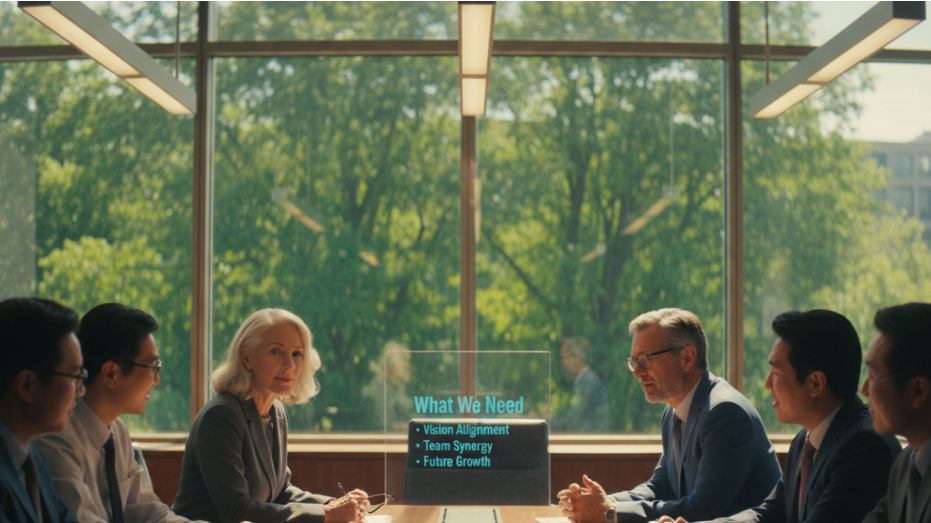
The board room filled gradually.
David arrived first, his expression neutral in a way that suggested careful preparation. Then the other board members, faces Marcus had seen across this table a dozen times before, each carrying their own version of expectations and concerns.
Jennifer Park arrived last, her leather portfolio tucked under one arm, her reading glasses already in place. She nodded at Marcus as she took her seat, the acknowledgment of a former CIO who knew exactly what it felt like to sit on his side of the table.
The meeting opened with the usual business. Financial update from the CFO. Operations review from the COO. Market analysis that showed competitors continuing to advance while Thornfield held steady.
Steady. The word felt like a euphemism for stuck.
Then David turned to Marcus.
“Let’s hear about the AI initiatives.”
Marcus stood. The stress ball was in his pocket, he realized. He’d grabbed it unconsciously on his way out of his office. He left it there.
“We’ve been pursuing AI implementation for eighteen months,” he began. “Three primary use cases: customer service automation, predictive maintenance, and procurement optimization.”
He clicked to his first slide. A timeline showing the original plan and the actual progress, the gap between them visible in red.
“We’ve faced challenges that were more significant than anticipated: integration complexity, data quality issues, talent retention.” He paused. “And an incident that exposed gaps in our governance approach.”
Jennifer’s eyes hadn’t left his face since he started speaking. She hadn’t written anything in her notebook. She was just watching.
“Current status: the customer service chatbot is operational with human review for edge cases. The predictive maintenance analysis is producing outputs that require validation before action. The procurement optimization is in limited deployment.”
“Define ‘limited,'” Jennifer said.
“Restricted to product categories where our data quality is verified. Approximately 20% of our catalog.”
“And the other 80%?”
“Still requires data remediation before the AI can produce reliable predictions.”
Jennifer nodded slowly – the kind of nod that preceded questions no one wanted to answer.
“What’s the total investment to date?”
“$1.4 million. Initial pilot budget plus vendor platform, data remediation, integration consulting, and observability infrastructure.”
“And the return on that investment?”
Marcus had prepared for this question. He had spreadsheets showing efficiency gains, cost avoidance estimates, productivity improvements. The numbers were defensible, if you squinted.
“Measurable efficiency gains in customer service response time. Early indicators of maintenance optimization.” He clicked to a slide with charts. “The ROI calculations suggest we’re tracking toward breakeven within – ”
“Marcus.” Jennifer’s voice was gentle, which somehow made it worse. “I’ve seen ROI calculations that track toward breakeven. I’ve also seen them adjusted quarter after quarter when the breakeven keeps receding.”
The room was quiet.
“What I’m asking is simpler: For $1.4 million and eighteen months, where are we? Not where are we tracking. Where are we actually?”
Marcus set down the clicker. The slides felt suddenly irrelevant.
“We’re in pilot purgatory,” he said.
The phrase landed in the room like something that had been waiting to be spoken.
“We have projects that work in controlled conditions and fail in production complexity, models trained on data that isn’t ready for the purpose, and a team that keeps shrinking as talent leaves for companies that can offer dedicated AI roles.” He paused. “And we have a CTO trying to manage AI transformation with 10% of his attention while the other 90% goes to keeping the existing business running.”
Jennifer removed her glasses and set them on the table with deliberate precision. She looked at Marcus with nothing between them, no barrier, no buffer.
“That’s the most honest assessment I’ve heard in eighteen months.”
“It’s the first honest assessment I’ve been able to give.”
“Why now?”
Marcus thought about the papers he’d read at midnight, Sarah’s research, and the four engineers who had left for competitors who understood something Thornfield hadn’t.
“Because I finally understand that the problem isn’t technical, isn’t about budget or talent or technology selection. It’s structural.” He met Jennifer’s eyes. “I’ve been solving this like an infrastructure problem, like the ERP migration or the cloud transition, technology challenges I could add to my portfolio and manage alongside everything else.”
“And AI doesn’t work that way.”
“No. It doesn’t.”
The room temperature had shifted.
Marcus could feel it in the way people were sitting, the way David had leaned forward, the way the other board members were exchanging glances that suggested this meeting had departed from the expected script.
Jennifer picked up her glasses but didn’t put them on. She held them loosely, using them to gesture as she spoke.
“I want to be clear about something. This isn’t about Marcus. This isn’t about blame or accountability in the punitive sense.” She looked around the table. “Every company I’ve worked with has gone through some version of this. The difference is how quickly they recognize the pattern and what they do about it.”
She opened her portfolio and pulled out a slide printout. Marcus couldn’t see the details from where he stood, but he recognized the format: a strategy document, something prepared.
“I’ve been watching this industry for twenty years,” Jennifer continued. “The companies that succeed with AI have something in common, and it’s not better technology, bigger budgets, or smarter engineers.”
“What is it?” David asked.
“Dedicated leadership. Someone whose only job is making AI work, not a CTO with AI added to their responsibilities or a committee that meets monthly, but a person who wakes up every morning thinking about AI strategy, AI governance, AI execution.”
She slid the printout across the table toward David.
“A Chief AI Officer.”
Marcus felt something unexpected: relief.
Someone had finally named it. The structural gap that explained eighteen months of struggle. The thing he had been circling without quite reaching.
“What does a CAIO actually do?” David asked, studying the document Jennifer had provided.
Jennifer glanced at Marcus, inviting him to answer. The gesture was deliberate. She wasn’t trying to humiliate him. She was trying to help him see.
“Dedicated accountability for AI outcomes,” Marcus said. “Not AI as a side project within a broader technology mandate. AI as the primary focus.”
Jennifer nodded. “What else?”
“Expertise in vendor evaluation. The ability to distinguish between demo capabilities and production reality. The experience to know what questions to ask and how to interpret the answers.” He thought about Linda’s vendor selection, the thirty-two RFPs that all said the same things. “The specialized knowledge we didn’t have when we were evaluating platforms.”
“And?”
“Governance-first mindset. Building the guardrails before the deployment, not after the incident. Understanding that security and monitoring aren’t friction, they’re foundation.”
Jennifer nodded again, but her expression said she was waiting for something else.
Marcus thought about the board presentations he’d given. The demos that had impressed everyone. The progress reports celebrating technical milestones while no one asked the harder question.
“Value discipline,” he said slowly, the realization forming as he spoke. “We optimized for working demos instead of business outcomes. Every pilot graduated into debates about potential, not budgets backed by proven results. We never forced a value thesis at the start. Never defined what success actually meant in dollars.”
Jennifer’s smile was slight but genuine. “Value case drift. It’s one of the most common patterns I see. Teams celebrate that something works without asking whether it’s worth what it costs to make it work at scale.”
“One more thing,” Jennifer said.
Marcus paused. He thought about his calendar. The twelve-hour days. The context switching between AI and cloud and security and infrastructure and all the other demands of running technology for a manufacturing company.
“Full-time attention on a full-time problem,” he said. “Not 10% of someone’s job producing 100% of an AI transformation’s requirements.”
The words echoed the research paper he’d been reading at midnight. The same pattern, the same conclusion.
“Exactly,” Jennifer said.
David studied the document for a long moment.
“This is a significant investment,” he said. “A new executive role, compensation, team-building.”
“Compared to what you’ve already invested?” Jennifer’s voice was matter-of-fact, not confrontational. “The $1.4 million that hasn’t produced a single system in full production? The talent you’ve trained and lost to competitors? The opportunity cost while other companies ship?”
“There’s also a fractional option,” Marcus said.
The words surprised him. He hadn’t planned to say them.
“What do you mean?” David asked.
“Some companies start with fractional CAIOs. Experienced AI leaders who work part-time across multiple organizations. Less investment than a full-time hire, but dedicated expertise that the existing team doesn’t have.”
Jennifer was watching him with something that looked like approval.
“You’ve been researching this.”
“Since the incident. Since the fourth engineer left for Strathmore.” He paused. “Strathmore has a CAIO. They hired someone eighteen months ago, right when we were getting started. That’s why they announced success while we were still trying to figure out the basics.”
“How do you know this?”
“One of my engineers left to join them. He told me in his exit interview.”
The connection landed. David’s expression shifted as he processed what that meant. The same starting point, the same industry, the same timeline. Different structures, different outcomes.
“What would have been different?” David asked. “If we’d had someone like this from the beginning?”
Marcus thought about the question: the vendor selection that had prioritized demos over due diligence, the security concerns pushed to the backlog, the data quality issues acknowledged but not addressed, the governance frameworks treated as friction instead of foundation.
“Everything,” he said. “Not because I’m incompetent. Because the structure doesn’t support it. I can’t give 100% attention to AI while also giving 100% attention to everything else. The math doesn’t work.”
“And yet we expected it to work.”
“We expected it because that’s how we’ve always done technology initiatives: add it to the CTO’s plate, allocate budget, set milestones, and trust that good people will figure it out.”
“But AI is different.”
“AI is different.” Marcus felt the weight lifting, the relief of finally being able to say what he’d known for months but couldn’t quite articulate. “It requires dedicated expertise. Specialized governance. Full-time attention from someone who isn’t also responsible for keeping the rest of the technology stack running.”
Jennifer leaned forward. “This is the conversation I wanted to have eighteen months ago. When I asked you if you had the bandwidth and focus to make this real.”
“I remember.”
“I should have pushed harder. Made the structural argument more explicitly.” She shook her head. “But I also trusted that a capable CTO could figure it out. Because that’s what capable CTOs do.”
“The competence trap,” Marcus said.
“Exactly. Your success in traditional IT made this harder, not easier. You applied the frameworks that had always worked. They didn’t work for this.”
The irony was bitter and familiar. He had been confident because he was competent. And his competence had led him to expect he could solve a problem that required a different kind of solution.
“So what now?” David asked.
Jennifer picked up her glasses and slipped them back on. The gesture seemed to signal a shift from diagnosis to prescription.
“We have options: a full-time CAIO if you’re ready for that investment, a fractional engagement to start if you want to validate the model before committing, or continue as is and hope for different results.”
“Option three isn’t really an option,” David said.
“No, it isn’t.”
Marcus looked at the slides he had prepared, the projections that felt thin and the timelines that had already slipped. Then he looked at the printout Jennifer had provided, the job description for a role he hadn’t known existed a year ago.
“I wish we’d had this conversation eighteen months ago,” he said.
“So do I.” Jennifer’s voice was kind, which somehow made the regret sharper. “But the second best time is now.”
The meeting continued for another hour, the conversation shifting from diagnosis to planning.
David asked questions about the fractional CAIO model, the cost structures, the typical engagement patterns. Jennifer answered with the precision of someone who had researched this thoroughly, who had been preparing this recommendation while waiting for the organization to be ready to hear it.
Marcus listened more than he spoke. The weight in his chest had changed character – still heavy, but differently so, the weight of recognition instead of the weight of denial.
They agreed on next steps: Jennifer would provide contact information for fractional CAIO firms she had vetted, David would discuss budget implications with the CFO, and Marcus would prepare a transition plan for how AI initiatives would be restructured under dedicated leadership.
The meeting adjourned at 12:37 PM. Board members filtered out with the usual post-meeting conversations, but the energy was different – something had shifted.
Marcus stayed behind, stacking his papers, gathering his laptop. The conference room was quiet except for the hum of the cooling system.
David caught him at the door.
“You handled that well.”
“I finally told the truth.”
“That takes courage. Most people in your position would have kept spinning.”
Marcus thought about the spinning he had done for eighteen months, the progress reports that emphasized achievements over obstacles and the projections that assumed the next quarter would be different.
“I ran out of spin… the evidence was too clear.”
David nodded. “What are you feeling?”
The question surprised Marcus. David wasn’t usually one for emotional check-ins.
“Relief,” he said. “More than I expected. Someone finally named the thing I couldn’t name.”
“The structural problem.”
“The structural problem. The impossibility of what we were trying to do.” He paused. “I was trying to be a CAIO while also being a CTO. Those are two full-time jobs. I was giving each of them 50% and wondering why neither was working.”
“You weren’t failing. You were being asked to do something that can’t be done.”
“I know. I think I’ve known for months. I just didn’t have the language for it until now.”
David clapped him on the shoulder. “Get some lunch. Take the afternoon. We’ll figure out the next steps tomorrow.”
Marcus watched David leave, then stood alone in the conference room where it had all started. The autumn light from that first meeting felt like a different era. A different version of himself, confident in ways he could no longer afford to be.
He pulled out his phone and found the paper Sarah had given him. “Pilot Purgatory: Why 95% of Enterprise AI Projects Stall.” He had read it a dozen times now. The words had moved from challenging to validating.
He forwarded it to Sarah with a single message: “You were right. About all of it.”
Her response came within minutes: “I know. What happens now?”
“We get help. Real help. The kind we should have had from the beginning.”
The drive home took longer than usual.
Marcus didn’t mind. The afternoon traffic gave him time to think, to process what had happened in that conference room.
He thought about Daniel, working at Terfim AI now, building the future he had wanted to build at Thornfield. The 40% raise had been part of it, but not the whole story, because Daniel had wanted dedicated focus and a role that was entirely AI, not AI squeezed in between legacy maintenance.
He thought about Linda, evaluating thirty-two vendors without the expertise to distinguish between impressive demos and production reality. She had done her best with the frameworks she knew. The frameworks just weren’t sufficient.
He thought about Sarah, the escalation email she had never sent, the security concerns that had been pushed to the backlog. She had been right about the risks. She had also been right that the structure wasn’t designed to prioritize them.
He thought about Priya, staying late to catch AI recommendations based on data that was garbage. The house on quicksand. The walls that kept cracking.
And he thought about himself. Twenty years of enterprise IT. Six years as CTO. A track record of successful transformations that had taught him to believe he could solve any technology problem if he applied enough effort and intelligence.
The competence trap.
His phone buzzed. A text from his wife: “How did it go?”
He considered the question. The honest answer was complicated.
“Better than expected,” he typed back. “I’ll explain when I get home.”
He pulled into his driveway as the sun was starting to set. The house looked the same as it had that morning, but something had shifted in the way he saw it. The burden he’d been carrying had been named, and named burdens were easier to address.
In his briefcase, the paper on pilot purgatory sat on top of his stack of documents. The title had felt like an accusation six months ago. Now it felt like an explanation. A framework for understanding what had happened and why.
He gathered his things and walked to the door.
Tomorrow there would be work to do: finding a fractional CAIO, restructuring the AI initiatives, and having difficult conversations with his team about what was changing and why.
But tonight, for the first time in eighteen months, he felt like the path forward was clear.
Not because the problems had been solved, but because they had been properly diagnosed.
And that, he was learning, was where real solutions began.
What happens next:
Six months later, everything has changed. Elena Chen, the fractional CAIO, has restructured the AI initiatives from the ground up. One pilot was killed entirely. The chatbot was rebuilt with guardrails first. And Marcus discovers what it looks like when AI transformation is done right.
The Epilogue + Full PDF release publishes February 18, 2026.
The Resolution: What a CAIO Changes
This chapter reveals the structural solution to pilot purgatory:
- Dedicated Leadership – Someone whose only job is making AI work, not a side project on a CTO’s plate
- Vendor Expertise – The ability to distinguish demo capabilities from production reality
- Governance-First Mindset – Building guardrails before deployment, not after the incident
- Value Discipline – Forcing a value thesis at the start, not celebrating demos without measuring ROI
- Full-Time Attention – 100% focus on a problem that demands 100% attention
- The Fractional Option – Dedicated AI expertise without the full-time executive investment
- The Competence Trap – Recognizing that past success in IT doesn’t guarantee AI transformation success
Want to learn more about fractional CAIO engagements? Contact NeuEon to discuss your AI transformation.
Why we wrote this
Scott Weiner is the AI Lead at NeuEon, Inc., where he helps organizations navigate the complexities of AI adoption and digital transformation. This story draws from patterns observed across dozens of enterprise AI initiatives.
Erwann Couesbot is the CEO of FlipThrough.ai, specializing in AI strategy for professional services. His conversations with technology leaders inspired many of the dynamics explored in this narrative.
Reading the series for the first time? Start with Part 1: The Mandate
Missed Part 2? Read Chapter 2: Foundations
Missed Part 3? Read Chapter 3: Procurement
Missed Part 4? Read Chapter 4: Departure
Missed Part 5? Read Chapter 5: The Incident
Missed Part 6? Read Chapter 6: The Weight
Want to read the complete story? [contact-form-7 id=”3e42a8d” title=”Contact Form”]
Have your own AI transformation story? We’d love to hear it. Connect with Scott on LinkedIn or reach out to NeuEon at neueon.com/contact.